I understand your idea of the COG of the clubhead and I have no problem understanding the lathe example. I also can understand Toolish's comment about how the hosel twists around the COG of the clubhead when one twirls the vertical club. I don't disagree with all these points. I can even agree that PP#3 traces the SPL through the sweetspot when the clubhead in the immediate vicinity of ball impact (when the clubhead has rotated so that there is a small, but significant, difference between the sweetspot plane and the clubshaft plane).
What I cannot understand is what relevance these "facts" really have with respect to the golf swing. I never sense the hosel rotating around the sweetspot-PP#3 axis in a golf swing. I can only sense the clubface closing and opening, and it "feels" like the clubface is rotating around the clubshaft axis. It is my present belief that the reason why I harbor this "belief" is that I presently believe that natural human biomechanical actions dictate opening of the clubface opening in the backswing and clubface closing in the downswing/followthrough, and that these actions have no necessary causal connection with the idea of there being a axis between the sweetspot and PP#3. However, I am open to new insights.
I can understand why human beings open the clubface in the backswing, because the left wrist has to remain flat and the left arm has to rotate clockwise in the backswing to get the left hand to the usual end-backswing position. However, I do not know whether the Robot-Fit type machine also rotates the clubface that much in the backswing, and if it does, how it gets the clubface to rotate back to square by impact if the wrist joint simply consists of two enmeshing gears that operate passively in response to centrifugal release forces.
I think the sample of a center shafted club would be great tool for analysis, especially in such a discussion.
So, if we swing such a club without changing anything else, would it mean that we would hit the ball dead center of the face = where the shaft is attached behind...or...would we toe the ball each time ?
I think the sample of a center shafted club would be great tool for analysis, especially in such a discussion.
So, if we swing such a club without changing anything else, would it mean that we would hit the ball dead center of the face = where the shaft is attached behind...or...would we toe the ball each time ?
NMGolfer remarks have a lot of sense, IMO.
Cheers
Nice idea. Id think that assuming we are swinging the sweet spot, we would hit the sweet spot. Homer Kelley in his tape with Tom Tomessello (on the Peter Croker site) said something to the effect that "if you are not swinging the sweet spot, you're swinging the shaft and if you are doing that, your in trouble". Im thinking shank.
He also spoke of old long nosed clubs and how they promoted CF closing the face. This makes sense to me. Take a center shafted putter and compare it to a heel shafted putter. Even at these low speeds you can feel the heel shafted putter "gateing". Crenshaw's old 8802 putter for example, you have to time its closing but it is sweet and packs a little extra punch too I think.
Nice idea. Id think that assuming we are swinging the sweet spot, we would hit the sweet spot. Homer Kelley in his tape with Tom Tomessello (on the Peter Croker site) said something to the effect that "if you are not swinging the sweet spot, you're swinging the shaft and if you are doing that, your in trouble". Im thinking shank.
He also spoke of old long nosed clubs and how they promoted CF closing the face. This makes sense to me. Take a center shafted putter and compare it to a heel shafted putter. Even at these low speeds you can feel the heel shafted putter "gateing". Crenshaw's old 8802 putter for example, you have to time its closing but it is sweet and packs a little extra punch too I think.
OB
I tend to agree. However, a small but important implication is that in case of a center-shafted club the shaft plane = the sweetspot plane.
Therefore, we can go further and create a variable weighted toe/heel of such a club and see if e.g. with a heavy toe/light heel center shafted club (imitating the proportions of a standard club to a degree) the shaft plane still equals the sweetspot plane.
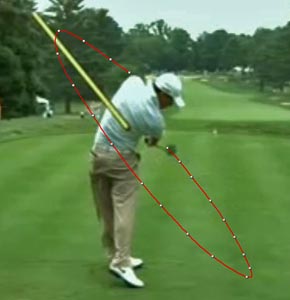
I always attempt to mimick his swing pattern - by attempting to be on the same inclined plane in the backswing and downswing (while slowly and progressively shifting planes between the elbow plane and turned shoulder plane in the backswing and vica versa in the downswing), and to always be on-plane even during the followthrough and early finish. I try to always get my clubshaft to be parallel to the ball-target line at the third and fourth parallels.
This is the clubhead path that I try to emulate.
When starting the backswing, I trace the SPL during the takeaway - and that means that the PP#3-sweetspot axis line points at the ball-target line. After the first parallel, it is the butt end of the club that points at the ball-target line and not any "hypothetical" axis of sweetspot rotation. For me, the most critical part of the swing in terms of being on-plane is between the first parallel and the third parallel. If I can keep on-plane during that time period and get to the third parallel perfectly on-plane, then I know that my clubshaft will be perfectly on-plane during the downswing time period between the third parallel and impact. In other words, I am mainly focused on ensuring that my clubshaft is on-plane when the club is above waist level, and during that time it is the butt end of the club, and therefore clubshaft, that points at the baseline of the inclined plane. In other words, all your theorising about options 1,2, and 3 have no relevance with respect to my above-waist biomechanical movements that are required to keep the clubshaft -on-plane.
I have tied a string between the sweetspot and PP#3 and it is no value, because the only time that I actually see the string is during the takeaway, at which time I can easily stay on-plane. The string has no value for the critical biomechanical movements that occur above waist level- in both the backswing and downswing. Seeing the string blur between the third parallel and impact has no potential value because if I am not on-plane during that time period, then it is far too late to alter events.
In fact, I have now trained my hands (specifically PP#3) to move correctly by "feeling" it trace the SPL and I never even think of the clubshaft and/or the sweetspot. My only awareness of the clubshaft is after I have completed the shot - when I replay the shot in my mind. I can then usually recall where the clubshaft was situated at the third and fourth parallel, and I know retrospectively that if the clubshaft wasn't parallel to the ball-target line at those two time points, then I obviously didn't succeed in my goal of being on-plane throughout the entire swing.
Jeff.
p.s. I am not a good golfer by Ben Hogan's standards, but I am a great golfer by my standards. I never dreamt that I would ever regularly break 80 (from the senior tees) considering my degree of physical inflexibility and lack of golf athleticism. I never play 7,200 yards courses because I am not a masochist. I only play 6,000-6,500 yards courses by always playing from the senior tees. My driving distance is 220-240 yards.
I always attempt to mimick his swing pattern - by attempting to be on the same inclined plane in the backswing and downswing (while slowly and progressively shifting planes between the elbow plane and turned shoulder plane in the backswing and vica versa in the downswing), and to always be on-plane even during the followthrough and early finish. I try to always get my clubshaft to be parallel to the ball-target line at the third and fourth parallels.
This is the clubhead path that I try to emulate.
When starting the backswing, I trace the SPL during the takeaway - and that means that the PP#3-sweetspot axis line points at the ball-target line. After the first parallel, it is the butt end of the club that points at the ball-target line and not any "hypothetical" axis of sweetspot rotation. For me, the most critical part of the swing in terms of being on-plane is between the first parallel and the third parallel. If I can keep on-plane during that time period and get to the third parallel perfectly on-plane, then I know that my clubshaft will be perfectly on-plane during the downswing time period between the third parallel and impact. In other words, I am mainly focused on ensuring that my clubshaft is on-plane when the club is above waist level, and during that time it is the butt end of the club, and therefore clubshaft, that points at the baseline of the inclined plane. In other words, all your theorising about options 1,2, and 3 have no relevance with respect to my above-waist biomechanical movements that are required to keep the clubshaft -on-plane.
I have tied a string between the sweetspot and PP#3 and it is no value, because the only time that I actually see the string is during the takeaway, at which time I can easily stay on-plane. The string has no value for the critical biomechanical movements that occur above waist level- in both the backswing and downswing. Seeing the string blur between the third parallel and impact has no potential value because if I am not on-plane during that time period, then it is far too late to alter events.
In fact, I have now trained my hands (specifically PP#3) to move correctly by "feeling" it trace the SPL and I never even think of the clubshaft and/or the sweetspot. My only awareness of the clubshaft is after I have completed the shot - when I replay the shot in my mind. I can then usually recall where the clubshaft was situated at the third and fourth parallel, and I know retrospectively that if the clubshaft wasn't parallel to the ball-target line at those two time points, then I obviously didn't succeed in my goal of being on-plane throughout the entire swing.
Jeff.
p.s. I am not a good golfer by Ben Hogan's standards, but I am a great golfer by my standards. I never dreamt that I would ever regularly break 80 (from the senior tees) considering my degree of physical inflexibility and lack of golf athleticism. I never play 7,200 yards courses because I am not a masochist. I only play 6,000-6,500 yards courses by always playing from the senior tees. My driving distance is 220-240 yards.
The string's not meant to help you with anything other than Basic Motion (2 feet back and through).
I have no problem with Kim. He has great Alignments. But, it seems like everything is Plane oriented. Do you ever work on the physics?
I am a masochist. I played last week with my best friend in Franklin, TN last week. We played from 7,190. It was 38 degrees and the wind was blowing, and it was soaking wet. I hit 3 wood into four par 4's and one par 3. I normally hit 3 wood 250 yards, but I wasn't planning on that distance in that weather. I shot 76 with two doubles, two bogeys, and two birdies. No one died, but we felt like it.
You wrote-: "I have no problem with Kim. He has great Alignments. But, it seems like everything is Plane oriented. Do you ever work on the physics?"
I don't understand your statement that everything is plane-oriented. Anthony Kim has an incredible ability to swing on-plane, but I don't think that doing so causes some other part of his swing action to be deficient. Do you?
What do you mean when you ask about working on the physics?
I am not consciously masochistic like you - I do not enjoy playing in wet 38 degrees weather with heavy winds blowing. I have played in Ireland or Scotland every year for the past 4 years, and the wind there causes me immense trouble. I recall one hole in Ireland that was only 320 yards in length, but the wind velocity was >40mph. I hit a perfectly executed drive which only traveled 150 yards. I then hit a really solid three wood and the ball went about 100 yards. I finally hit a perfect 8 iron that traveled 60 yards. I missed my par putt. I personally don't enjoy the experience of hitting the ball (as well as I can) and having to hit three well struck shots in order to reach a 320 yard hole.
I tend to agree. However, a small but important implication is that in case of a center-shafted club the shaft plane = the sweetspot plane.
Therefore, we can go further and create a variable weighted toe/heel of such a club and see if e.g. with a heavy toe/light heel center shafted club (imitating the proportions of a standard club to a degree) the shaft plane still equals the sweetspot plane.
Cheers
Not sure I follow you 100%, but Id think that with a heavier toe the sweet spot would move and you'd be back to a non aligned shaft and sweet spot.
All of this begs the question: Why arent there face balanced , center shafted irons? There must be a very good reason. We must need the rotation perhaps? Or is there something else? Homer suggested the long nosed, low profile irons of the 1930's were a delight to hit.
I've sort of struggled with tracing conceptually as there seemed to be a parallax issue. I now realize that while I was swinging the sweet spot, I was trying to trace the shaft plane. Lukes point about tracing the sweet spot plane, the imaginary string from #3 to sweet spot is insightful. Like pointing your finger at a bird in flight, tracing. This way I am aiming that which I am swinging, the sweet spot!
Per 2-F PLANE OF MOTION. "Regardless of where the Clubshaft and Clubhead are attached it will always feel as if they are joined at the Sweet Spot---the longitudinal center of gravity, the line of pull of Centrifugal Force."
All of this begs the question: Why arent there face balanced , center shafted irons? There must be a very good reason. We must need the rotation perhaps? Or is there something else? Homer suggested the long nosed, low profile irons of the 1930's were a delight to hit.
OB
That's the point ! Hell knows why aren't there face balanced clubs, but IMO not because someone wanted to make golfer's life harder.
I would risk to say that because of tradition. Backing to the middleages when golfers played with wooden stick bent at one end (looking similarily to a walking stick for elderly people)...and it was much easier to manyfacture it instead manufacturing a center shafted club.
Sir Winston Ch. could be right - we are playing with tools that are wrongly designed to this goal...
That's the point ! Hell knows why aren't there face balanced clubs, but IMO not because someone wanted to make golfer's life harder.
I would risk to say that because of tradition. Backing to the middleages when golfers played with wooden stick bent at one end (looking similarily to a walking stick for elderly people)...and it was much easier to manyfacture it instead manufacturing a center shafted club.
Sir Winston Ch. could be right - we are playing with tools that are wrongly designed to this goal...
Cheers
Maybe but I tend to think that there is a very good reason that manufacturers dont make clubs that way. I think. They would never lie to us would they? No need for an answer. Remember titanium centered golf balls?
Perhaps trying a center shafted, face balanced putter at full speed vs a heel shafted, toe drop one would answer this question but maybe ruin some putters. Im thinking that with the face balanced one it would be harder to control the initial direction of the ball (face angle) and less powerful. Just a guess though.
I do know that Homer thought the old school 1930's longer nosed irons enabled CF to "have more control over the alignment of the club face, more powerful, more difficult to disturb".
Here is the link to the Croker sites audio tape. Its mainly about hip motion, action, Hula Hula etc but about 5 minutes in there is some stuff relevant to this discussion.




 Hybrid Mode

